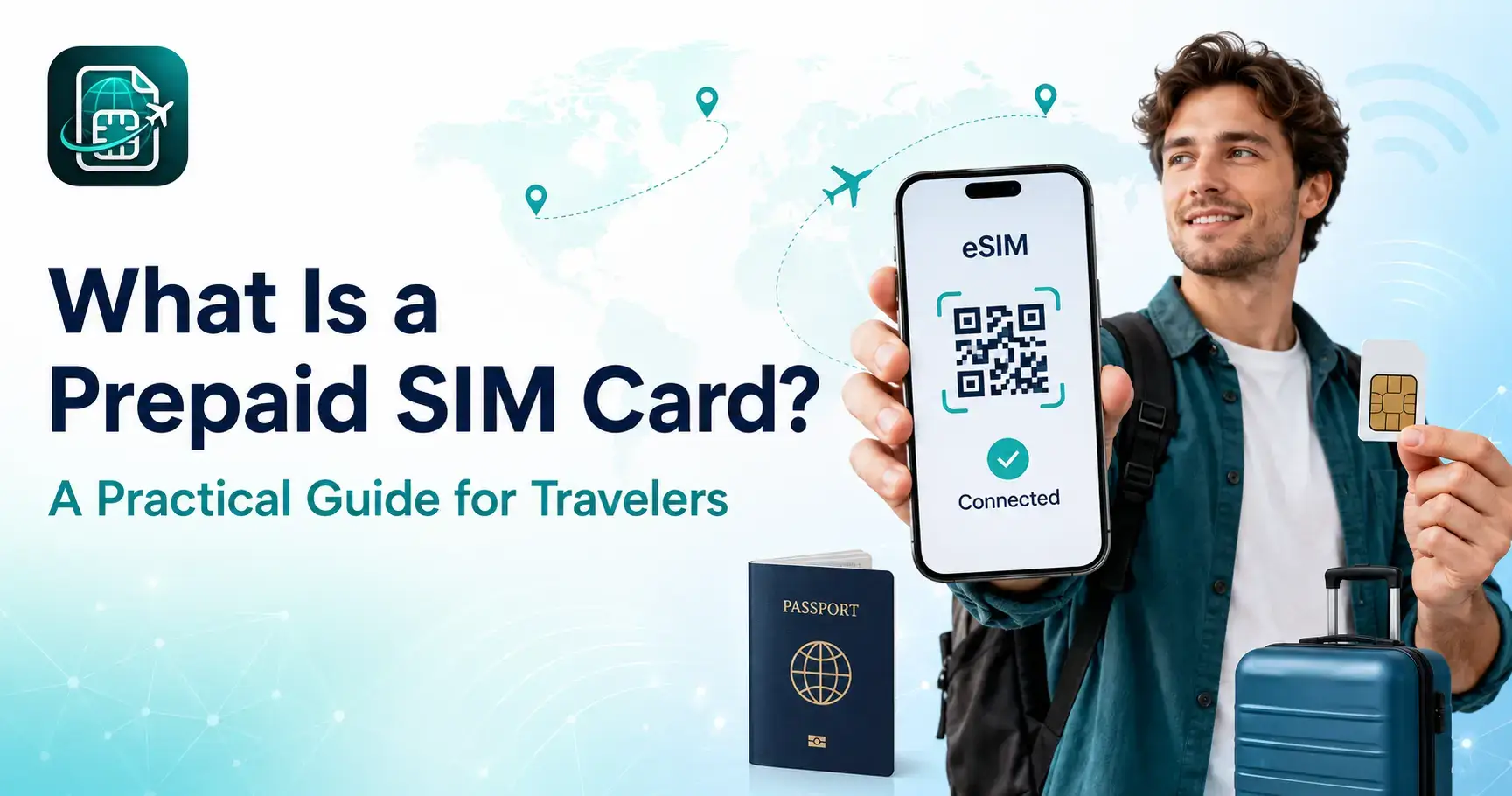
Wondering what a prepaid SIM card actually is before you buy one for your next trip? In simple terms, a prepaid SIM card is a SIM you pay for in advance, giving you a set amount of data, calls, or texts without a contract or credit check. You use what you've paid for, then top up or replace it when it runs out. It's a popular choice for travelers who want mobile connection without long-term commitments or surprise bills.
This guide breaks down how prepaid SIM cards work, how they compare to prepaid eSIMs, and how to decide which option fits your next trip.
What Is a Prepaid SIM Card?
A prepaid SIM card is a small chip issued by a mobile network operator that stores your subscriber information and connects your phone to that network. Unlike a postpaid plan, where you're billed after using the service, a prepaid SIM requires payment upfront.
Once you've paid, the network activates an allowance of data, minutes, or texts tied to that SIM. When the allowance runs out or the validity period ends, you either top up the balance or the SIM stops working until you do.
Prepaid SIM cards are widely used by:
- Travelers who want local or regional connectivity without a long-term contract
- People who prefer to control their spending with no risk of overage charges
- Users without a credit history in the country they're visiting, since prepaid plans typically don't require a credit check
The core idea is simple: pay first, use what you paid for, and there's no ongoing obligation once the balance or validity period expires.
How Does a Prepaid SIM Card Work?
A prepaid SIM works by linking your phone to a mobile network through a small plastic card that holds a SIM chip. Here's the general process:
- Purchase — You buy the SIM card from a store, kiosk, vending machine, or online retailer, either before or after arriving in your destination.
- Insert — You physically remove the SIM from its card and insert it into your phone's SIM tray.
- Activate — Depending on the country and carrier, activation may happen automatically, through a text message, an app, or by registering identification at a store.
- Use your allowance — Once active, you can use the data, calls, or texts included in your plan until it runs out or expires.
- Top up or replace — When your balance runs low, you can usually add more credit through an app, website, retail location, or scratch card, depending on the carrier.
Because there's no contract, prepaid SIM cards are generally straightforward: no credit checks, no monthly bills, and no obligation to continue past your prepaid balance.
What Is a Prepaid eSIM?
A prepaid eSIM works on the same prepaid principle — pay in advance for a set data allowance — but without a physical card. An eSIM (embedded SIM) is a digital SIM profile built into compatible phones, tablets, and smartwatches. Instead of inserting a physical chip, you install a mobile plan digitally, usually by scanning a QR code or tapping a link.
A prepaid eSIM is especially relevant for international travel because it can often be purchased and installed before you even leave home. Many travel eSIM providers, including eSIMVora, let you browse and buy a data plan for a specific country or region online, then activate it once you land — no store visit, no waiting in line, no swapping out your existing SIM.
It's worth noting that eSIM compatibility depends on your specific device model, your region, and whether your phone is carrier-unlocked. Not every phone supports eSIM, and even models that do may have region-specific restrictions, so it's worth checking your device settings or manufacturer's support page before relying on one for a trip.
Prepaid SIM vs Postpaid SIM
Understanding the difference between prepaid and postpaid plans helps clarify why so many travelers lean toward prepaid options.
Prepaid SIM:
- Payment is made before use
- No contract or credit check typically required
- Spending is capped at what you've paid
- Easy to start and stop using without cancellation steps
- Common for short-term visitors and travelers
Postpaid SIM:
- You're billed after using the service, usually monthly
- Often requires a contract and credit check
- May include higher data allowances or bundled perks
- Risk of overage charges if you exceed your plan
- More common for long-term residents with an established address and credit history
For travelers, prepaid plans are generally more practical since they don't require local credit history, a permanent address, or a long-term commitment.
Physical Prepaid SIM vs Prepaid eSIM
Both physical prepaid SIM cards and prepaid eSIMs follow the same "pay before you use it" model, but they differ in how you get and use them. Here's a side-by-side look:
| Factor | Physical Prepaid SIM | Prepaid eSIM |
|---|---|---|
| Installation | Manually inserted into a SIM tray | Installed digitally via QR code or app |
| Delivery speed | Requires pickup or mail delivery | Often available instantly online |
| Need to visit a store | Sometimes required, especially for local registration | Usually not required |
| Retaining your physical SIM | Must remove your existing SIM to insert the new one (unless using a dual-SIM phone) | Original SIM can often stay in place |
| Device compatibility | Works with virtually any unlocked phone | Requires an eSIM-compatible device |
| Carrier-unlocked requirement | Required to use a different carrier | Also required for eSIM to work with a new carrier |
| Calls and SMS availability | Varies by plan and carrier | Varies by provider; many travel eSIMs are data-only |
| Data-plan availability | Widely available through local carriers | Widely available through international eSIM providers |
| Switching between plans | Requires swapping physical cards | Can often add or switch digital profiles without removing anything |
| Suitability for international travel | Useful when eSIM isn't supported or a local number is needed | Convenient for connecting before or immediately upon arrival |
Neither format is automatically better — the right choice depends on your device, your itinerary, and what you need connectivity for.
Benefits of Using a Prepaid SIM
Prepaid SIM cards, whether physical or digital, offer several practical advantages for travelers:
- No long-term contract — You use it for as long as you need and walk away when you're done.
- Predictable spending — You know exactly what you're paying for upfront, with no surprise charges.
- No credit check — Ideal for travelers without local credit history.
- Flexibility — You can choose plans based on trip length, data needs, or destination.
- Avoiding roaming charges — Using a local or regional prepaid plan can help you sidestep expensive home-carrier roaming fees.
Possible Limitations
Prepaid SIM cards also come with some trade-offs worth knowing about:
- Data caps — Once your allowance is used, you'll need to top up or lose service.
- Validity periods — Many prepaid plans expire after a set number of days, even if you haven't used all the data.
- Feature variation — Not every plan includes calls or texts; many travel-focused eSIM plans are data-only, so check the plan details before assuming voice or SMS is included.
- Device restrictions — eSIM options depend on having a compatible, unlocked device.
- Registration requirements — Some countries require ID registration for physical SIM cards, which can take extra time at a store.
How Prepaid SIM Cards Work When Traveling Internationally
When you travel abroad, your home SIM typically switches to roaming mode, which can be expensive depending on your carrier and destination. A prepaid SIM card — physical or eSIM — purchased for the country or region you're visiting connects you to a local or regional network directly, often at a lower cost than roaming.
For example:
- A traveler visiting Italy for two weeks might buy a prepaid SIM or eSIM with a data allowance sized for that trip, rather than relying on their home carrier's roaming rates.
- A digital nomad working across several countries in Southeast Asia might prefer a regional prepaid eSIM that covers multiple destinations without needing a new SIM in each country.
- A business traveler with back-to-back international meetings might install a prepaid eSIM before departure so they land already connected, without searching for a SIM vendor at the airport.
In each case, the traveler pays upfront for a defined amount of data, uses it during the trip, and isn't tied to any ongoing commitment once the trip ends.
How to Choose a Prepaid SIM or eSIM for Travel
When comparing options for an upcoming trip, consider:
- Device compatibility — Confirm whether your phone supports eSIM, and whether it's carrier-unlocked.
- Trip length and data needs — Match the plan's data allowance and validity period to your itinerary.
- Destination coverage — Check whether the plan covers a single country or multiple regions if you're traveling to more than one place.
- Calls and SMS requirements — If you need to make calls or send texts, confirm the plan includes them, since many travel eSIMs are data-only.
- Activation timing — Some eSIMs can be installed before departure, which is useful if you want to land already connected.
If you're exploring options for an upcoming trip, you can browse plans by destination on the eSIMVora website to see what's available for where you're headed.
How to Activate a Prepaid eSIM
Activation steps can vary slightly by provider, but the general process looks like this:
- Check compatibility — Confirm your device supports eSIM and is carrier-unlocked.
- Purchase a plan — Choose a data plan for your destination.
- Receive your QR code or activation details — This is typically delivered by email or through the provider's app.
- Install the eSIM — Go to your phone's mobile network settings, choose the option to add a new eSIM plan, and scan the QR code or follow the installation link.
- Enable the plan when needed — You can often install the eSIM in advance and only turn on data roaming for that profile once you land, helping avoid early activation of your validity period.
Because steps can differ by device and provider, it's worth checking your phone's specific instructions, available on the eSIM-compatible devices page, before your trip.
Who Should Use a Physical SIM?
A physical prepaid SIM tends to make more sense for:
- Travelers with older or budget devices that don't support eSIM
- People who want a local phone number for the duration of their stay
- Long-term travelers or expats who prefer a SIM they can physically manage, remove, or replace
- Destinations where physical SIMs are cheaper or more widely available than digital alternatives
Who Should Use an eSIM?
A prepaid eSIM tends to suit:
- Travelers with newer, eSIM-compatible smartphones
- People who want to activate connectivity before arriving at their destination
- Digital nomads and frequent travelers who don't want to manage multiple physical SIM cards
- Anyone who wants to keep their home SIM active for calls or messages while using a separate data plan abroad
If your device supports it, a prepaid eSIM for international travel can simplify the process considerably compared to sourcing a physical SIM in an unfamiliar country. You can learn more about how the technology works on the "What Is eSIM" page.
Frequently Asked Questions
What is a prepaid SIM card?
A prepaid SIM card is a SIM you pay for in advance, giving you a set allowance of data, calls, or texts without a long-term contract. You use the plan until it expires or runs out, then top up or replace it.
What is the difference between a prepaid SIM and an eSIM?
A prepaid SIM is a physical chip you insert into your phone, while an eSIM is a digital profile installed directly onto a compatible device. Both can be offered on a prepaid basis, but eSIMs don't require a physical card.
Can an eSIM be prepaid?
Yes. Most travel-focused eSIM plans, including those offered by international eSIM providers, are sold on a prepaid basis — you pay upfront for a set data allowance.
Does a prepaid SIM card have a phone number?
Typically, yes — a physical prepaid SIM usually comes with a local phone number. Some prepaid eSIM data plans also include a number, but many travel eSIMs are data-only and don't assign a dedicated number, so it depends on the specific plan.
Can I use a prepaid SIM card internationally?
Yes, but using your home country's prepaid SIM abroad usually triggers roaming charges. Many travelers instead buy a prepaid SIM or eSIM specific to their destination to get local or regional rates.
Is a prepaid eSIM good for international travel?
It can be a convenient option for travelers with compatible devices, since it often allows you to set up connectivity before departure and avoid hunting for a local SIM vendor. Whether it's the right choice depends on your phone's compatibility and your specific travel needs.
Do prepaid eSIM plans include calls and SMS?
Not always. Many prepaid eSIM plans designed for travelers are data-only. If calls or texts are important to you, check the plan details before purchasing.
How do I know whether my phone supports eSIM?
You can check your device settings under mobile or cellular plans, or consult your phone manufacturer's support documentation. Compatibility also depends on your region and whether the device is carrier-unlocked.
Can I keep my regular SIM active while using an eSIM?
On dual-SIM capable devices, yes — you can often keep your physical SIM active for calls and texts while using an eSIM for data, though exact functionality depends on your device and carrier settings.
Do prepaid SIM cards expire?
Most prepaid SIM and eSIM plans have a validity period, after which unused data or credit may no longer be accessible unless you top up. Validity periods vary by provider and plan.
Final Thoughts
So, what is a prepaid SIM card? At its core, it's a straightforward, pay-as-you-go way to get mobile connectivity without a contract — whether that comes in physical form or as a digital eSIM profile. For international travel, the right choice comes down to your device, your trip length, and how you plan to use your connection abroad.
If you're getting ready for a trip and want to see what prepaid eSIM options are available for your destination, you can explore prepaid travel eSIM plans on eSIMVora and compare plans by country or region before you go.